
Views: 0 Author: Site Editor Publish Time: 2026-09-30 Origin: Site


Growing fabrication shops constantly face a difficult balancing act. You want to expand service capabilities by adding tube and pipe processing, but you must carefully manage limited capital and floor space. Determining whether investing in a dual-purpose machine solves production bottlenecks or creates a single point of failure is a major decision. A single point of failure can throttle your overall throughput, disrupt downstream welding stations, and hurt delivery times.
This guide provides a practical framework to evaluate shop volume, material mix, and facility constraints. We will examine equipment specifications, map out floor space requirements, and highlight common buying mistakes. By analyzing these factors, you can make an evidence-based purchasing decision that aligns with your production goals and keeps your shop running efficiently.
Integrated machines typically save 30–40% in floor space compared to standalone units but require strict production scheduling to avoid workflow bottlenecks.
Laser power (kW) must be specified based on the thickest, most frequently processed materials for both flat and structural profiles, rather than peak marketing claims.
Automation features—specifically pneumatic chucks and semi-auto loading—are critical for achieving ROI in high-mix, low-volume fabrication environments.
Machine build quality, including gantry rigidity and positioning accuracy, dictates long-term reliability and part tolerance consistency.
Understanding your actual production demand is the first step. You must calculate the current ratio of flat sheet processing to tube and pipe processing. Rely on historical production data rather than aspirational capabilities. Pull the routing data from your ERP system over the past twelve months. Categorize the exact spindle hours or arc-on time spent processing flat sheets versus structural profiles. This ratio dictates whether a dual-purpose machine will see enough daily use to justify the floor space.
Next, identify the hard costs of outsourcing your tube cutting. Calculate the monthly expenses paid to external vendors for processing structural profiles. Compare these outsourcing costs against the potential margin capture of bringing the work in-house. Factor in the reduced lead times, eliminated shipping fees, and the reduction in work-in-progress inventory. Establishing a minimum utilization threshold is necessary. You need to know exactly how many hours per week the machine must run to break even on the monthly equipment payment.
Space is a premium asset in any fabrication shop. A major advantage of an integrated laser cutting machine is its compact footprint. Compare the square footage required for a standalone flatbed laser plus a separate tube laser against a single combination unit. The combination unit usually saves significant floor space. However, you must account for the entire operational footprint, not just the machine dimensions.
Map out your material handling workflows carefully. Dual-format machines require complex staging areas. You need dedicated space for flat sheet pallets and separate cantilever racks for raw tubing. Ensure forklift access is unobstructed for both loading zones. Plan the routing for finished parts. Flat cut parts and processed tubes often follow different downstream paths, such as press brake bending or robotic welding. Your shop layout must accommodate these diverging workflows without creating traffic jams.
| Production Metric | Outsourcing Tube Cutting | In-House Integrated Machine |
|---|---|---|
| Lead Time | 1 to 3 weeks depending on vendor backlog | On-demand processing (same day or next day) |
| Quality Control | Dependent on third-party inspection | Immediate internal verification and adjustment |
| Material Handling | Requires receiving, uncrating, and staging | Direct from raw material rack to machine bed |
| Margin Capture | Low (paying vendor markup) | High (capturing full manufacturing value) |
An integrated machine requires a lower initial capital expenditure compared to purchasing two separate industrial-grade machines. You only buy one laser source, one water chiller, and one dust extraction system. This shared infrastructure creates immediate efficiency gains. Maintenance routines are centralized around a single piece of equipment. Operators only need to learn one software interface and one set of daily preventative maintenance tasks.
These machines fit perfectly in job shops dealing with a high product mix but lower overall volume per format. If your production schedule requires cutting sheets for four hours and tubes for four hours daily, a combo machine maximizes your asset utilization. You avoid having a dedicated tube laser sitting idle for half the week.
High-volume production environments often benefit from separate machines. The primary advantage is redundancy and risk mitigation. If a combo machine goes down for a scheduled lens replacement or unexpected maintenance, all cutting operations halt. Separate machines prevent this single point of failure. If the flatbed goes down, you can still process structural profiles.
Parallel processing is another major benefit. You can run high-volume sheet jobs and large tube batches simultaneously without scheduling conflicts. Separate machines also allow for dedicated operator workflows. Operators can optimize their setups for specific material formats without constantly switching fixtures or changing out chuck jaws.
When selecting a sheet and tube laser cutter, safety and configuration dictate your shop floor layout. Open-bed configurations offer easier access for loading odd-sized materials via overhead crane. However, they expose operators to scattered radiation and hazardous cutting fumes. Fully enclosed safety cabins are the industry standard for high-production environments.
These enclosures typically feature exchange tables for the flatbed section. Exchange tables allow operators to unload finished parts while the machine cuts the next sheet, drastically reducing idle time. To maximize the efficiency of an enclosed system, follow these workflow steps:
Stage raw material bundles directly adjacent to the loading zone before the shift begins.
Program the nesting software to alternate between long-running sheet nests and quick tube jobs to balance operator unloading times.
Assign a dedicated material handler to clear the exchange tables while the primary operator monitors the cutting head and gas pressures.
Implement a visual kanban system for scrap bins to ensure they are emptied before they interfere with the shuttle table movement.
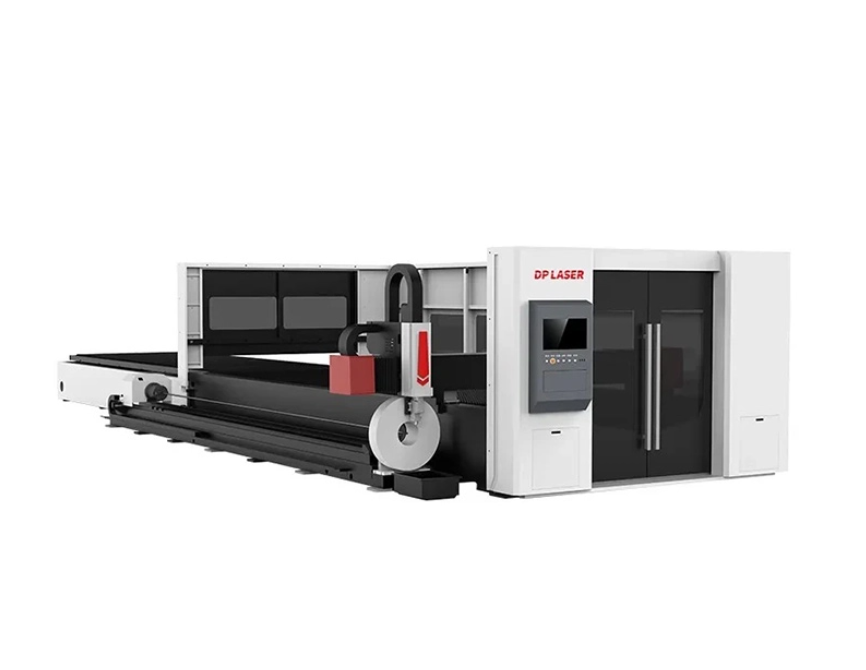
Fiber lasers dominate modern metal fabrication. They have entirely replaced legacy CO2 systems for cutting standard metals. Fiber sources offer superior energy efficiency, lower maintenance, and faster cutting speeds in thin to medium materials. When specifying a Sheet And Tube Laser Cutting Machine, matching the kW rating to your specific materials is non-negotiable. A 3kW source handles thin carbon steel and aluminum efficiently. If you frequently process thick stainless steel or heavy-wall structural pipe, you will need 6kW, 12kW, or higher.
Precision metrics determine the quality of your finished parts. Evaluate the positioning accuracy, which should typically be around ±0.03mm. Repeatability ensures that the thousandth part matches the first part exactly. You must balance cutting speed with edge quality. Pushing a machine to its maximum thickness limits often results in thermal distortion, heavy dross accumulation, and rough edges. Always test your actual materials during the evaluation phase rather than relying on vendor test cuts.
The physical construction of the machine dictates its lifespan. Use a strict pre-purchase inspection checklist. Evaluate the gantry rigidity first. A lightweight gantry vibrates at high speeds, causing jagged cuts and premature wear on the drive components. Look for heavy-duty welded machine beds that have been thermally stress-relieved. This manufacturing process prevents the frame from warping over time as the machine experiences dynamic loads.
Inspect the linear guide rails and rack-and-pinion systems. These components drive the motion and must be sourced from reputable manufacturers. Check the servo motor brands. High-torque servo motors ensure rapid acceleration and deceleration, which is vital for complex cutting paths and sharp corners. Long-term reliability depends entirely on the quality of these foundational components.
Your machine must handle your standard raw material sizes without excessive prep work. Standard sheet capacities usually range from 5x10 feet to 6x12 feet. Ensure the bed handles full-size sheets with no repositioning required. Repositioning introduces alignment errors and wastes valuable production time.
Tube cutting parameters require careful scrutiny. Check the maximum allowable tube diameter and the minimum/maximum tube length. Verify the weight capacity per meter. Heavy-wall structural pipes can easily overload a standard rotary axis, causing the servo motors to fault out. Ensure the machine software and chucks are compatible with open profiles like angle iron and channel steel, not just round or square tubing.
The rotary chuck is the heart of the tube cutting mechanism. You must choose between pneumatic and electrical chucks. Pneumatic chucks offer strong, consistent clamping force and are highly durable in dirty environments. Electrical chucks provide superior programmable precision and self-centering capabilities, allowing you to adjust the clamping pressure for thin-walled tubes that might otherwise crush.
Material handling automation directly impacts your cycle times. Manual loading is physically demanding and slows down production. Semi-auto loading systems reduce operator fatigue and keep the machine running continuously. Seamless transitions between flat and structural materials depend heavily on how efficiently your team can load the raw stock.
| Chuck Type | Clamping Force | Precision & Control | Best Application |
|---|---|---|---|
| Pneumatic Chuck | High and fixed | Moderate (mechanical centering) | Heavy-wall pipe, thick structural steel, dirty environments |
| Electric Chuck | Variable and programmable | High (servo-driven centering) | Thin-wall aluminum, delicate extrusions, high-precision parts |
Hardware is only as effective as the software controlling it. Evaluating nesting software capabilities is a mandatory step. The provided software must efficiently handle both 2D sheet nesting and complex 3D tube intersections. Poor nesting software wastes raw material and creates unnecessary scrap. Look for software that automatically optimizes cutting paths to reduce head travel time and supports common-line cutting to save assist gas.
Consider the ERP and MES integration potential. Modern metal fabrication equipment should communicate seamlessly with your shop management systems. Tracking job costs, material yield, and machine utilization rates in real-time gives you a competitive edge. This data allows you to quote jobs more accurately, identify hidden production bottlenecks, and schedule preventative maintenance without disrupting major production runs.
Many shop owners make avoidable errors during the purchasing process. The most common mistake is over-specifying peak laser power while under-investing in material handling automation. A 15kW laser is useless if it sits idle waiting for an operator to manually load heavy steel plates with a forklift. Balance your budget between cutting power and automated loading systems to ensure the laser beam stays on.
Another frequent error is ignoring the capacities of peripheral equipment. Undersized dust extraction units fail to capture hazardous fumes, creating an unsafe work environment and coating your shop in fine metallic dust. Inadequate water chillers cannot maintain optimal temperatures during long cutting shifts in the summer, leading to laser source thermal shutdowns. Always verify that the peripherals are rated for the machine's maximum continuous output.
Operating a high-powered laser requires strict monitoring of daily consumables. You must track the usage rates of copper nozzles, ceramic rings, and protective lenses. A dirty protective lens will quickly absorb laser energy, shatter, and potentially destroy the expensive focusing optics inside the cutting head. Establish a daily inspection routine to prevent this.
Assist gas consumption is another major operational factor. Cutting with nitrogen provides a clean, oxide-free edge ready for welding, but it consumes massive volumes of gas at high pressures. Cutting with oxygen is slower and leaves an oxide layer, but uses significantly less gas. Many shops are now transitioning to high-pressure compressed air cutting for thin materials to reduce gas expenses. You must evaluate your facility's ability to supply these gases consistently.
Operating a dual-purpose machine involves a steep learning curve. The risk of operator error is high when transitioning between flat and rotary cutting modes. A sheet metal laser cutter requires different focal length adjustments, standoff distances, and assist gas pressures than a tube laser cutter. Mistakes during setup can lead to costly collisions between the cutting head and the material, resulting in days of downtime.
Mitigate this risk by mandating comprehensive vendor training checklists. Training must cover safety protocols, manual focal length adjustments, centering the laser beam, and emergency stop procedures. Secure a service level agreement that includes ongoing technical support. Designate specialized in-house programmers who deeply understand the nesting software. Do not rely on a single operator; cross-train multiple team members to ensure continuous operation across all shifts.
Installation delays can severely disrupt your production schedule. Unexpected issues often arise due to inadequate foundation stability. High-speed laser cutters generate significant dynamic forces as the heavy gantry accelerates at 2G or higher. If the concrete floor is too thin or lacks rebar reinforcement, vibrations will ruin your cutting accuracy and cause the machine to walk out of square.
Conduct rigorous pre-installation site audits to mitigate these risks. Hire structural engineers to verify floor load capacities and core-drill the concrete if necessary. Work with licensed electricians to ensure your power supply meets the exact voltage and amperage requirements of the machine, chiller, and dust collector. Enforce strict vendor compliance checks before accepting delivery. The installation site must be completely prepped, swept, and cleared before the rigging truck arrives.
Take the following actionable steps to finalize your equipment decision:
Request specific time studies from vendors based on your most complex DXF and STEP files to verify actual cycle times.
Demand custom cutting samples on your actual shop materials to inspect edge quality and dross accumulation.
Audit your facility's electrical capacity, compressed air volume, and concrete foundation thickness before signing a purchase order.
Map out the exact floor space required for the machine, safety enclosures, raw material staging, and finished part routing.
A: Buyers often ignore software compatibility with existing ERP systems. Underestimating facility power and ventilation requirements is another frequent error. Many shops also buy based solely on maximum wattage rather than analyzing their actual daily production needs, material thicknesses, and material handling bottlenecks.
A: A high-quality fiber laser machine typically lasts 10 to 15 years under standard operating conditions. The laser source itself usually maintains peak performance for about 100,000 operational hours. Strict adherence to preventative maintenance schedules, especially regarding optics and guide rails, significantly extends the overall lifespan.
A: Most standard combination machines are designed for round, square, and rectangular tubing. They can handle light open profiles like angle iron and channel. However, they are generally not equipped to process heavy structural steel like large H-beams or I-beams due to weight limits and chuck clearance.
A: The footprint varies by model, but a standard 5x10 foot combo machine requires roughly 400 to 600 square feet. This includes necessary clearance for raw material loading, finished part unloading, exchange tables, the water chiller, the dust collector, and the safety enclosure.
A: Pneumatic chucks use compressed air to provide strong, rapid clamping force and require minimal maintenance in dirty environments. Electric chucks use servo motors, offering highly precise, programmable clamping pressure. Electric chucks are better for thin-walled tubes that might crush under heavy pneumatic pressure.
A: The laser source performs identically to a standalone machine. However, the gantry design on a combo machine is sometimes heavier to accommodate the dual functionality and extended travel. This can result in marginal acceleration and speed differences compared to dedicated, ultra-high-speed flatbed lasers.
A: Daily routines include cleaning the protective lenses and inspecting the cutting nozzles for damage or spatter. Operators must check chiller fluid levels and empty the dust extraction bins. Wiping down the linear guide rails and lubricating the rotary chucks are also essential daily tasks.


