
Views: 0 Author: Site Editor Publish Time: 2026-10-12 Origin: Site


Are you still risking precious gems with the unpredictable heat of traditional soldering torches? I have spent years evaluating welding equipment for high-volume trade shops, and the verdict is clear. Upgrading to a modern optical system saves countless bench hours. It acts as an absolute safeguard against accidental heat damage to delicate stones. Stepping into the world of advanced optical equipment is undeniably a major financial commitment for any business owner.
When you first start browsing, technical jargon like Joules, peak Watts, and internal chillers can quickly feel overwhelming. Whether you lean toward a traditional desktop setup or explore the versatility of a modern Jewelry Laser Welder, making the right choice dictates your daily workshop efficiency. I will cut through the complex terminology in this guide. We will help you select the perfect machine based on your specific metallurgical needs, daily volume, and budget.
Key Takeaways
Identify Your Primary Use Case: Determine if your daily workload leans heavily toward high-volume retail repairs, like retipping prongs and seamless ring sizing. Alternatively, you might focus on intricate architectural custom fabrication.
Understand Power Metrics: Evaluate machines based on Joules rather than average Watts. A standard jewelry environment typically demands between 60J and 150J. This depends heavily on the thermal conductivity of your chosen metals.
Cooling Systems Matter: A robust internal water-to-water cooling system is an absolute necessity for continuous manufacturing or busy trade shops. It prevents thermal shutdown mid-weld.
Form Factor: Choose between a stationary desktop chassis for microscopic bench work or a flexible gun-style unit for bulkier pieces.
ROI is Rapid: Eliminating the need to unset and reset heat-sensitive stones drastically slashes labor time. This yields a remarkably fast return on investment despite the initial capital expenditure.
To make an informed purchasing decision, we need to look under the hood. These machines are highly specialized industrial tools. They fuse precious metals using intensely amplified light. This entirely bypasses the need for messy traditional solder alloys.
The system operates by generating a highly focused beam of light. This beam is traditionally routed through a Neodymium-doped Yttrium Aluminum Garnet crystal or a modern optical fiber source. The material absorbs the light energy when this concentrated beam strikes a gold or platinum surface. It instantly converts into localized heat. This rapid reaction creates a microscopic melt pool known as the heat-affected zone.
The pulse flashes in mere milliseconds. Therefore, the heat remains strictly confined to the impact site. Bench jewelers can execute structural welds literally millimeters away from heat-intolerant gems like opals, pearls, or heavily included emeralds without inducing thermal shock. You can comfortably touch the surrounding metal with your bare fingers immediately after the sharp snap of the pulse.
Wielding a gas torch and operating a Micro Precision Welder are fundamentally different processes. Traditional soldering demands heating a broad area to coax a lower-melting-point alloy into a joint via capillary action. Over time, this foreign alloy can oxidize. It leaves behind a dark and highly visible seam.
Optical welding is a true fusion process. You feed a filler wire crafted from the exact same alloy as the base piece directly into the melt pool instead of solder. The result is a seamless and homogenous joint completely free of color variance. You can build up metal vertically layer by layer to reconstruct heavily worn prongs or fill microscopic casting porosity. A torch would simply melt those delicate areas into a messy puddle.
Identifying your primary workshop persona is the crucial first step in your buying journey. The technical specifications you require will pivot drastically depending on your daily tasks.
This technology serves as the ultimate repair optimization engine for the bustling retail jeweler. It revolutionizes mundane daily tasks by slashing turnaround times. Re-tipping worn prongs is arguably the most frequent bench application. The concentrated beam allows you to fuse matching wire directly onto the prong tip while the diamond remains securely set.
Ring sizing also transforms into a streamlined operation. Jewelers can seamlessly fuse the sizing stock while holding the piece barehanded instead of blasting the entire shank with a torch and risking side stones. These machines are also lifesavers for porous castings. A few quick pulses with matching wire fill the voids perfectly when a freshly cast pendant emerges with irritating surface pits.
The machine acts as an invincible extra set of hands for high-end fabricators. Master jewelers frequently utilize the beam to temporarily tack complex components together. This instant fusion locks the geometry securely in place before final permanent welding or large-scale torch soldering.
This unique capability unlocks the creation of intricate architectural designs. These pieces would stubbornly shift or collapse if bound by traditional binding wire and tweezers. The surgical accuracy ensures delicate components are never warped by excessive ambient heat.
Recent market analyses indicate a fascinating shift in the jewelry manufacturing sector. Traditional enclosed bench setups remain the bedrock of retail repair. However, industry search trends highlight a surging demand for flexible solid-state technologies. Workshops are increasingly pivoting toward systems that mitigate the downtime associated with consumable degradation.
Buyers are carefully weighing physical form factors against long-term maintenance needs. We see a significant migration from traditional crystal rod systems to fiber optic solutions in high-production environments. This transition is driven by the need for higher thermal stability, lower energy consumption, and the ability to handle highly reflective metals like silver and copper with greater ease.
When staring down a dense specification sheet, the numbers can blur together. I always advise my clients to isolate a few critical metrics. This helps you confidently select a chassis capable of conquering your specific metallurgical challenges.
The most pervasive mistake newcomers make is evaluating a unit solely by its average power. Pulse Energy measured in Joules is the true benchmark of capability in this realm. Joules represent the actual striking force of a single pulse.
Different alloys possess wildly different thermal conductivities. Standard 14k gold absorbs energy beautifully. A machine outputting 60J will handle it with ease. Sterling silver and platinum are notoriously stubborn. Silver acts as an infrared mirror. It bounces the light away while instantly bleeding heat from the weld zone. You must arm your bench with a machine capable of delivering a peak pulse energy between 100J and 150J to conquer these demanding metals.
A machine is only as good as its focus. You must prioritize an adjustable beam diameter. The spot size directly dictates the width of your weld pool. Industry-standard machines allow operators to dial the beam from a microscopic 0.1mm up to a broad 2.0mm.
Navigating around delicate pavé-set diamonds demands a 0.1mm to 0.2mm spot size. A wide 1.5mm setting is indispensable for deeply penetrating thick men's bands. Ensure the optics maintain a crisp and perfectly circular profile even at the widest parameters.
Generating intense light produces a massive byproduct of internal heat. How the chassis manages this thermal load dictates its duty cycle. This is essentially how long you can hold the pedal down before the machine forces a pause.
Compact entry-level units typically rely on basic air-to-air fans. These suffice for kiosk shops doing a handful of jobs daily. A heavy-duty internal water chiller becomes mandatory if your facility processes dozens of repairs back-to-back. The crystal rod overheats without aggressive liquid cooling. This causes your beam energy to wildly fluctuate mid-weld and risks catastrophic damage to the internal optics.
Bench work is physically taxing. Staring through lenses for hours on end will inevitably lead to severe neck strain if the machine is poorly designed. Carefully evaluate the physical chassis. Does it feature plush armrests? Is the viewing angle naturally aligned with a seated posture?
Optical clarity is equally vital. Your unit should boast a high-grade stereo microscope providing pristine 10x to 15x magnification. The internal crosshairs must align flawlessly with the focal point. This guarantees that where your eyes rest is exactly where the metal will melt.
Metal aggressively scavenges oxygen from the surrounding air when it reaches a liquid state at extreme temperatures. This results in brittle and soot-covered joints. Professional-grade fusion requires an inert shielding environment.
Argon is the undisputed industry standard. Verify that your prospective machine includes an integrated argon nozzle nestled directly inside the chamber. A gentle hiss of argon floods the zone milliseconds before the light fires. This displaces ambient oxygen and yields a bright seam that demands drastically less post-weld filing.
To make your selection easier, let us look at a practical comparison based on real-world engineering specs. Comparing traditional setups to modern fiber solutions provides a clear picture of capability differences.
| Specification | Desktop YAG System such as DPH-SS Series | Handheld Fiber System |
|---|---|---|
| Best For | Micro-repairs, retipping prongs, fine chain links | Large silver hollowware, bulky custom fabrication |
| Energy Output | 60J to 100J Peak Pulse Energy | 1000W to 2000W Continuous Power |
| Cooling Method | Built-in Water Chiller or Air Cooling | Heavy-duty Industrial Water Chiller |
| Viewing Method | 10x High-Clarity Stereo Microscope | Laser Safety Goggles and Direct Vision |
| Maintenance | Flash lamp replacement every 3 to 5 million shots | Zero-maintenance solid-state source up to 100,000 hours |
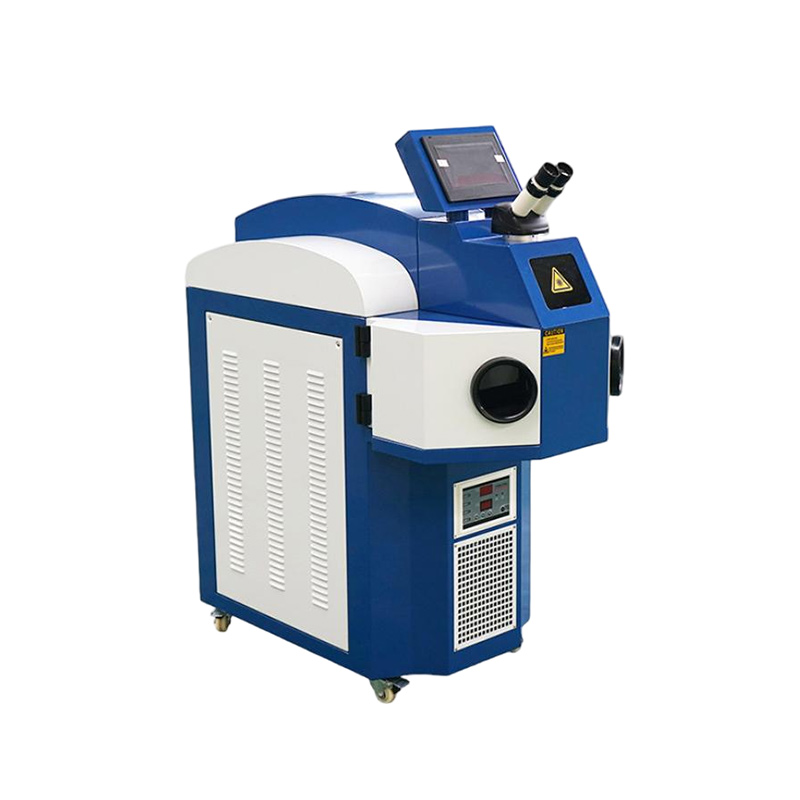
For decades, the undisputed king of the bench has been the enclosed desktop or freestanding pedestal unit. These rely predominantly on traditional technology utilizing synthetic crystal rods excited by high-intensity flash lamps.
This traditional architecture provides unparalleled physical stability. The craftsman sits comfortably while resting both forearms on the machine. This allows for the microscopic hand-eye coordination vital for rebuilding a tiny prong. The light-tight enclosure guarantees absolute eye safety from stray reflections. You can operate without cumbersome external safety goggles.
Driven by the demand for higher throughput and zero-maintenance longevity, the industry is rapidly embracing fiber optic technology. These modern systems generate their beam within active optical fibers. This results in highly concentrated and incredibly efficient energy delivery.
This technological leap has paved the way for the Handheld Laser Welder. Operators wield a specialized ergonomic gun instead of working inside a restrictive internal chamber. This format offers limitless spatial freedom for silversmiths tackling hollowware or mixed-metal manufacturers crafting bulky watch bands. The operator simply brings the tool to the workpiece to execute rapid continuous seam welds.
Signing the purchase order is merely the beginning. Successfully integrating this sensitive industrial equipment into your existing workspace demands strategic logistical foresight.
Rigorously measure your available footprint before unboxing. Desktop iterations demand a rock-solid workbench capable of bearing up to 100 pounds. You need ample rear clearance to allow the cooling fans to breathe. Pedestal models command their own dedicated floor space.
Electrical infrastructure is a frequent stumbling block. Modest 60J machines might happily hum along on a standard 110V household outlet. High-draw beasts pushing 150J for silver work almost universally require a dedicated 220V single-phase circuit. Forcing a high-power machine onto a shared breaker will trigger voltage drops. This results in weak penetration and infuriatingly inconsistent performance.
Vaporizing alloys releases sub-micron metallic dust and noxious fumes into the air. This is a severe respiratory hazard, particularly when dealing with vintage pieces containing cadmium solders.
Deploying a robust fume extractor equipped with HEPA and activated carbon filtration is non-negotiable. Position the extraction hose directly near the chamber exhaust. Safety protocols must be equally ironclad. Every occupant must don specialized safety eyewear rated for the exact 1064nm wavelength if you operate an open-air handheld system.
Financial planning for this caliber of equipment requires looking past the initial sticker shock. You must calculate the tangible daily labor savings the machine will inject into your business.
The true value of this technology is measured in reclaimed labor hours. Consider a routine sizing on a ring featuring heat-sensitive emeralds. A jeweler spends 15 minutes meticulously unsetting the stones using a traditional torch. They spend 10 minutes sizing the metal and another 20 minutes resetting and repolishing.
The stones remain untouched by utilizing localized optical heat. The shank is cut, sized, and seamlessly fused in just 10 minutes. You save roughly $35 per sizing if your shop's labor rate sits at $60 per hour. Executing just three of these operations daily generates over $500 in weekly labor savings. A mid-range Laser Spot Welder pays for itself entirely within a few short months under these conservative metrics.
Navigating the complex electro-optical market is fraught with pitfalls. Sidestepping these common blunders will save your workshop from agonizing downtime.
The loudest complaint echoing through jewelry forums comes from buyers who underestimated sterling silver. An entry-level 60J beam will merely bounce off or leave superficial pitting because silver acts as an exceptional thermal conductor. You must invest in high peak power and advanced pulse-shaping features if your brand relies heavily on silver fabrication.
These are not simple household appliances. Traditional crystal systems require periodic maintenance. You must flush coolant lines and replace xenon flash lamps every few million shots. Purchasing a deeply discounted grey-market import with zero domestic support is a massive gamble. Prioritize vendors who offer comprehensive warranties and rapid troubleshooting.
Choosing the ideal optical fusion system is an exercise in balancing your capital budget against specific metallurgical demands. You can easily filter out inadequate machines by carefully evaluating your Joule requirements and cooling needs.
Integrating this technology will fundamentally transform your workflow. It eliminates the terrifying risk of heat-fracturing precious stones. It drastically slashes the labor hours tied to traditional soldering and resetting.
Take the time to rigorously assess your workshop's physical footprint and electrical capabilities today. If you are ready to scale your production and eliminate bench bottlenecks, explore the advanced solutions available. Whether you need the precision of a desktop unit or the raw power of a Fiber Laser Welder, you can find the exact match for your metallurgical needs at DP Laser Machine.
Yes, but they require vastly different parameter settings and power outputs. Platinum is relatively easy to work with because it has low thermal conductivity and absorbs energy highly efficiently. It requires lower voltage and shorter pulse durations. Silver is highly reflective and thermally conductive. The machine needs higher peak power, typically 100 Joules or more, to fuse silver successfully.
The penetration depth depends entirely on the machine's peak pulse energy and the specific alloy. A standard 60J to 80J desktop unit can comfortably achieve a weld depth of 0.5mm to 1.5mm in gold and platinum. High-power fiber systems can penetrate upwards of 3.0mm to 4.0mm in a single pass. Operators can bevel the edges of thicker pieces and build up the weld in multiple layers for deep structural joints.
While not strictly mandatory for every single quick tack-weld, using argon gas is highly recommended for professional structural results. Argon acts as an inert shielding gas that floods the zone to push away ambient oxygen. This prevents oxidation and soot formation during the melting process. It results in a clean shiny joint that requires significantly less filing afterward.
Maintenance depends on the technology type. Traditional YAG systems require the water coolant to be changed every six months and the internal water filter replaced annually. The xenon flash lamps degrade over time and need replacement every 3 to 5 million shots. Modern solid-state fiber systems require virtually zero maintenance on the light source itself, only requiring standard cleaning of the exterior protective lenses.
There is an initial learning curve, particularly regarding the ergonomics of hand-eye coordination while staring through a high-magnification stereo microscope. Operators must learn how to dial in the correct voltage and pulse duration for different alloys. However, the process is generally considered much easier to master than traditional torch soldering. Most bench jewelers become highly proficient after a few weeks of consistent daily practice.


