
Views: 0 Author: Site Editor Publish Time: 2026-10-14 Origin: Site


Walk onto any busy manufacturing floor today, and you will see the same operational bottlenecks. Plant managers face severe skilled labor shortages. Raw material costs are escalating rapidly. Meanwhile, the market demands higher production speeds and absolute pinpoint accuracy. Traditional fabrication methods rely heavily on a welder's manual dexterity and physical stamina. These older methods are simply struggling to keep pace with compounding industrial pressures.
The ultimate solution to scaling production without sacrificing component quality is the Robotic Laser Welder. Moving from manual arc processes to highly automated robotic systems is no longer a luxury reserved for massive automotive plants. It is a fundamental necessity for staying competitive in today's fast-paced industrial landscape.
This comprehensive guide explores exactly what processes, materials, and complex workflows a robotic setup can successfully automate. We will look at how this technology integrates seamlessly into broader factory networks. Finally, we will outline the bottom-line return on investment that manufacturers can realistically expect from making the upgrade.
Versatile Automation: An automated setup handles far more than just the physical weld itself. It actively streamlines part handling, real-time seam tracking, and post-weld quality inspection across the floor.
Material Mastery: Advanced optical systems automatically join complex, highly reflective, and dissimilar metals that traditional MIG or TIG methods typically warp or destroy.
Seamless Integration: Today's intelligent controllers easily sync with broader manufacturing ecosystems. They communicate effectively with conveyors, optical sensors, and other robotic cells.
High Return on Investment: The initial capital investment is rapidly offset by drastic reductions in material scrap, zero need for post-weld grinding, and exponentially faster cycle times.
To evaluate the impact of automation on a fabrication floor, you must first understand the equipment's foundational architecture. A robotic laser welding system is a highly engineered integration of several core components working in unison. It primarily consists of a multi-axis articulated arm, a high-power solid-state fiber laser source, a specialized welding head featuring focusing optics and wobble technology, and a centralized industrial controller.
How does this compare to a standalone manual machine? The differences in throughput are staggering. Manual processing certainly improves speed over traditional TIG welding. However, adding a robotic arm introduces the critical elements of repeatable motion, continuous machine uptime, and advanced spatial positioning. A robot does not experience operator fatigue. It does not have unsteady hands. Consequently, the first weld executed at the beginning of a Monday shift is metallurgically identical to the final weld produced on a Friday night.
At the heart of this system is computer numerical control. The software uses pre-programmed, highly precise digital paths to execute complex joints without human intervention. By dictating the laser power, focal position, and travel speed in real-time, the controller ensures optimal energy delivery at every millimeter of the joint.
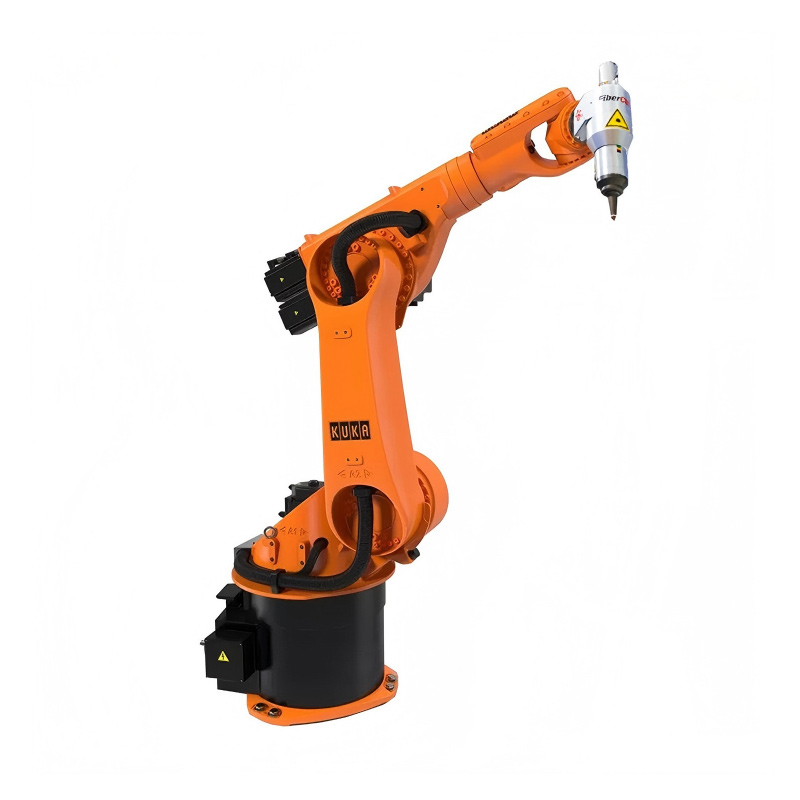
One of the most immediate benefits of automation is the execution of long, continuous welds on large components. Think of industrial storage tanks, HVAC enclosures, or structural panels. Robots can automate these extended seams at travel speeds up to ten times faster than manual TIG or MIG welding. Because the mechanical arm maintains a constant, unwavering velocity, it prevents localized heat buildup. This avoids burn-through and ensures a uniform bead appearance across the entire length of the metal.
In sheet metal fabrication, rapid and repetitive spot welds are frequently required to hold assemblies together before final finishing. A robotic system automates this process by replacing traditional resistance spot welding with non-contact precision. The laser head jumps between coordinate points in fractions of a second. Because the beam never physically touches the part, there is no tool wear or copper electrode degradation to worry about. The result is a highly automated, maintenance-free tacking process.
Human operators often struggle to maintain optimal torch angles when navigating cylindrical or irregularly shaped parts. This leads to inconsistent penetration. A six-axis robotic arm, however, effortlessly maneuvers around complex three-dimensional structures. By coordinating the robot movement with external positioners like rotary tables, the system automates the welding of complex tubular frames and exhaust systems. The beam remains perfectly perpendicular to the joint at all times.
The automotive industry relies heavily on joining flat sheets of different thicknesses, grades, or materials before they are stamped into final shapes. This process is known as tailor welded blanks. Automation is absolutely critical here. Robotic systems seamlessly join these varying sheets with a high-strength, low-profile weld. This allows automotive engineers to design chassis components that are thicker in load-bearing areas and thinner elsewhere. It optimizes vehicle weight without compromising crash performance.
Working with ultra-thin materials manually is a sweat-inducing task. It requires immense skill to manage heat input and prevent warping. A Precision Laser Welder automates this entirely by delivering highly concentrated energy with a microscopic heat-affected zone. The controller precisely modulates the pulse frequency and travel speed. This allows the system to join thin-gauge stainless steel and aluminum without burn-through or thermal deformation, completely eliminating the need for manual heat management.
As industries like battery manufacturing and electronics rapidly evolve, the need to join metals with vastly different melting points and thermal conductivities has surged. Robotic automation strictly controls the thermodynamics required to weld dissimilar metals, such as copper to aluminum. By managing the exact depth of the melt pool, the system creates strong mechanical and electrical bonds. It avoids forming the brittle intermetallic compounds often seen in manual arc processes.
Historically, highly reflective materials like aluminum, copper, and brass posed a significant danger to optical equipment due to beam back-reflection. Today, modern automated fiber lasers are equipped with advanced optical isolators and wobble-head technology. This beam oscillation disperses the energy safely. Furthermore, it allows the automated system to process reflective metals continuously without damaging the source generator or requiring manual intervention.
For a robotic cell to achieve maximum throughput, it must be fed continuously. These systems rarely operate in isolation. Instead, they are designed to function within a synchronized Automated Production Line. By working in tandem with pick-and-place robots, automated pallet changers, and conveyor belts, materials are continuously fed into the clamping fixtures. While the laser processes one part, external automation simultaneously unloads the finished product and clamps the next. This drives machine utilization rates close to one hundred percent.
Even with high-precision machining, parts can exhibit slight dimensional variations or fit-up gaps. Automation is only effective if it can adapt to these real-world inconsistencies. Integrated vision cameras and tactile sensors automate the alignment process. By scanning the joint before and during the actual weld, the robot automatically adjusts its path in real-time to compensate for thermal distortion or minor tooling inaccuracies. The beam stays exactly centered on the seam.
Quality control is traditionally a manual, time-consuming bottleneck. In a modern setup, the robotic cell can be integrated directly with automated optical inspection tools or three-dimensional profile scanners. These sensors verify weld integrity, measure bead width, and check for surface porosity immediately after the cycle completes. By automating quality assurance, manufacturers can instantly identify and isolate defective parts, preventing them from moving further down the line.
Looking at the current manufacturing landscape, a massive shift is underway across global factory floors. The industry is rapidly moving away from blind, repetitive execution toward adaptive, smart manufacturing ecosystems. Driven by the explosive growth of electric vehicle gigafactories and aerospace modernization, the demand for flawless, high-speed joining has never been higher. We are seeing a distinct trend where even mid-sized job shops are adopting automation just to survive severe labor shortages. In addition, artificial intelligence is beginning to play a tangible role. AI algorithms now analyze real-time acoustic and thermal data to autonomously adjust weld parameters on the fly. This predictive capability prevents defects before they occur, representing the next major frontier in fabrication technology.
The global shortage of highly skilled manual welders is a major bottleneck for production growth across the manufacturing sector. Automation directly addresses this issue. Instead of requiring a master craftsman for every single station, one trained operator can oversee multiple automated robotic cells simultaneously. This drastically reduces direct labor costs per part. It also ensures production schedules are met regardless of local labor market fluctuations.
Traditional arc welding often leaves spatter and bulky, unsightly beads that require labor-intensive manual grinding and polishing before painting. Because a Laser Welding Machine produces highly focused and clean joints, it automates away the need for these secondary finishing processes. This eliminates the massive amounts of time spent on rework. It also significantly reduces expenditures on abrasive consumables like grinding wheels and flap discs.
Human error inevitably leads to inconsistent heat input, resulting in warped parts and rejected assemblies. The absolute repeatability of a robotic setup ensures a perfect outcome every time, provided the parts are fixtured correctly. By maintaining strict control over energy input cycle after cycle, automation drives scrap rates down to near zero. This saves substantial capital on wasted raw materials.
| Metric | Manual TIG and MIG Welding | Robotic Laser Welding |
|---|---|---|
| Processing Speed | Moderate to Slow | Up to 10x Faster |
| Post-Weld Grinding | Highly Required | Rarely Needed |
| Heat-Affected Zone | Large | Minimal |
| Labor Dependency | Requires highly skilled craftsmen | One operator oversees multiple cells |
| Scrap Rate | Variable | Near Zero |
Selecting the correct robotic arm is a matter of physics and facility planning. Plant managers must assess the payload capacity to ensure the arm can safely support the weight of the heavy optical head and any integrated vision sensors. Look for an industrial six-axis robot with a reach ranging from 1400 millimeters to 2000 millimeters. This ensures the arm can access all joints on your largest manufactured parts. Additionally, the physical footprint of the Class 1 safety enclosure must be matched to your available floor space without disrupting current material flow.
Laser power directly dictates processing speed and penetration depth. A 1500W continuous wave fiber source is typically sufficient for automating thin-gauge sheet metal up to 2 millimeters thick and cosmetic consumer goods. Conversely, for deep penetration in heavy automotive components or highly reflective materials like copper, manufacturers should opt for 3000W or higher power sources. Matching the wattage to your material ensures you achieve required cycle times without overtaxing the equipment.
Hardware is only as effective as the software controlling it. When setting up a new line, ease of programming is a critical factor. Facilities should prioritize intuitive offline programming software. This allows engineers to simulate and generate paths from computer-aided design models on a PC without halting the physical machine. Modern teach pendants with graphical, user-friendly interfaces make it much faster for floor staff to make micro-adjustments on the fly.
Integrating robotic automation delivers benefits far beyond merely joining two pieces of metal. It automates efficiency, enforces strict quality control, and ultimately secures long-term profitability. By eliminating the bottlenecks of manual labor, eradicating post-weld grinding, and drastically reducing scrap, manufacturers can scale their output to meet modern market demands.
Whether your facility produces microscopic medical devices or heavy automotive chassis components, integrating a CNC Laser Welder into a synchronized production workflow is the clearest path to future-proofing your business.
Stop letting labor shortages and slow production cycles limit your growth. It is time to upgrade your shop floor with industrial-grade automation. Visit DP Laser to explore our high-performance AP Series and automated production line solutions. Contact our engineering team today to request a custom return on investment calculation tailored to your specific facility, and take the first step toward intelligent, highly profitable manufacturing.
Absolutely. While robotics are traditionally associated with mass production, modern offline programming software and quick-change modular tooling make it highly efficient to automate even small batch runs. Operators can switch between different part programs in a matter of seconds, making it ideal for custom job shops.
The initial capital expenditure for a robotic system is higher than standalone manual machines. However, the investment is highly justifiable. Due to exponentially increased throughput, eliminated post-processing, and reduced direct labor dependency, the return on investment is typically realized within 12 to 24 months for most facilities.
No. Modern robotic interfaces and advanced teach pendants have drastically simplified the programming process. Facilities do not need to hire specialized robotic engineers. Existing welding staff or machine operators can be trained quickly to operate, manage, and adjust the automated system.
Yes, when properly integrated. Automated systems are housed within Class 1 safety enclosures equipped with strict safety interlocks. These enclosures completely protect workers from harmful radiation, bright flashes, and hazardous fumes, creating a significantly safer and cleaner overall factory environment.
While fiber lasers are incredibly versatile, certain materials pose challenges. Materials with extremely high carbon content, such as cast iron, are prone to cracking due to the rapid cooling rates associated with laser processing. Additionally, low-boiling-point metals like zinc or magnesium require highly specialized parameter control to prevent excessive spatter and porosity.
With modern offline programming software, a completely new part can be programmed in a virtual environment in just a few hours without stopping production. Once the program is transferred to the machine, fine-tuning the physical path on the shop floor typically takes less than thirty minutes.


