
Views: 0 Author: Site Editor Publish Time: 2026-07-16 Origin: Site


Manufacturing precision demands are accelerating rapidly across modern industries. Traditional mechanical methods struggle to keep pace. They inherently rely on physical friction to separate materials. This friction causes micro-cracking and substantial edge damage along the cut path. These structural flaws demand extensive post-processing steps. Secondary grinding and polishing inevitably slow down production lines and inflate operational labor.
Modern applications require zero-friction, high-yield manufacturing to stay competitive. A modern Glass Laser Cutting Machine entirely eliminates these historical bottlenecks. We use focused light to replace physical blades, ensuring pristine material separation. This article explores how laser-based processing fundamentally transforms industrial glass fabrication. Production managers and facility engineers face complex automation choices daily. We will help you evaluate if this advanced technology aligns perfectly to support your specific application and scale requirements.
Primary Function: Glass laser cutting machines replace physical blades with focused light, utilizing either thermal stress splitting or cold ablation to achieve chip-free edges.
Core Applications: Highly specialized for consumer electronics (displays), medical devices (microfluidics), and complex automotive/architectural components.
Technology Choice: Selecting the right machine depends on matching the laser source (CO2, UV, or Ultrashort Pulse) to the specific glass thickness and required edge tolerance.
Implementation Reality: High upfront capital expenditure is offset by eliminating post-cut grinding and polishing stages, significantly improving overall production yield.
Mechanical force inherently introduces uncontrolled variables into the manufacturing process. Traditional diamond wheels and CNC routers rely on physical abrasion. They tear through material structures rather than separating them cleanly. This aggressive action generates immense mechanical stress along the cut line. Invisible micro-cracks propagate deep into the substrate during separation. These microscopic fractures drastically weaken the structural integrity of the final component. Mechanical routing also causes significant kerf loss. Kerf loss refers to the sheer volume of raw material ground into dust by the cutting tool. Furthermore, physical blades experience continuous tool wear. A diamond blade degrades slightly during every single cycle. This gradual degradation causes edge tolerances to drift continually. Facility managers must constantly halt production lines to replace worn tools.
Mechanical cuts never produce a final, install-ready edge. They mandate a rigorous sequence of secondary finishing operations. Manufacturers must transport freshly cut parts to secondary grinding stations. Grinding removes the worst mechanical chips but introduces heavy vibration. Following grinding, parts move through intense washing cycles to remove abrasive dust. Finally, mechanical polishing attempts to restore optical clarity to the raw edge. Every additional handling step exponentially increases the risk of accidental breakage. Complex routing geometries require specialized manual polishing. Manual finishing adds unpredictable cycle times and relies heavily on skilled labor availability.
We must view laser technology as a comprehensive yield-optimization strategy. Advanced manufacturing relies on highly engineered raw materials. Ultra-thin aluminosilicate glass features remarkable chemical strengthening. It also carries a premium procurement cost. Every single shattered panel represents lost raw material and wasted facility energy. Traditional mechanical snapping yields inconsistent break lines on ultra-thin substrates. Laser processing guarantees near-perfect separation consistency. Facilities replacing diamond scribing often see yield rates jump dramatically. Protecting high-value raw materials directly protects overall operational margins.
Modern consumer devices push material physics to their absolute limits. Manufacturers require exceptional precision for several key components.
Smartphones and Tablets: Screens require complex internal cutouts for camera lenses and acoustic sensors.
Wearable Technology: Smartwatch faces demand perfectly smooth, circular edges to ensure water-resistant sealing.
AR/VR Lenses: Augmented reality headsets use ultra-thin substrates measuring less than 1 millimeter thick.
These devices undergo constant physical impact during daily use. Any microscopic edge chipping creates a natural stress concentration point. A single drop will cause the screen to spider-web from that specific weak point. A glass laser cutter delivers pristine edges. It prevents these fatal stress fractures before device assembly even begins.
The scientific sector demands absolute environmental purity during component fabrication. Microfluidic chips handle microscopic biological samples. Laboratory slides and highly sensitive optical sensors require flawless surface integrity. Mechanical methods utilize liquid cutting fluids to manage tool heat. These fluids introduce unacceptable chemical contamination. Mechanical routing also generates airborne particulate dust. Laser ablation creates zero physical dust and requires zero cutting fluid. We achieve extreme micron-level precision completely dry. This capability proves essential for cleanroom manufacturing environments.
Next-generation vehicles integrate massive digital interfaces directly into the cabin architecture. Heads-up displays (HUDs) project critical telemetry onto specialized windshield sections. Modern curved dashboard panels stretch across entire vehicle consoles. Manufacturers build these components using complex laminated safety materials. Mechanical cutting often causes delamination between the structural layers. Laser systems process complex aerodynamic curves flawlessly. They cut through multi-layer materials without separating the vital bonding films.
Microelectronic packaging requires separating delicate wafers into individual sensor units. Thermal management remains the primary challenge in semiconductor fabrication. Standard heat sources easily damage adjacent microscopic circuits. Engineers require a specialized "cold cutting" approach. Ultrashort pulse lasers vaporize the substrate material instantly. The process occurs faster than thermal energy can conduct into the surrounding area. This prevents heat-affected zones (HAZ) from destroying sensitive micro-components located mere microns from the cut line.
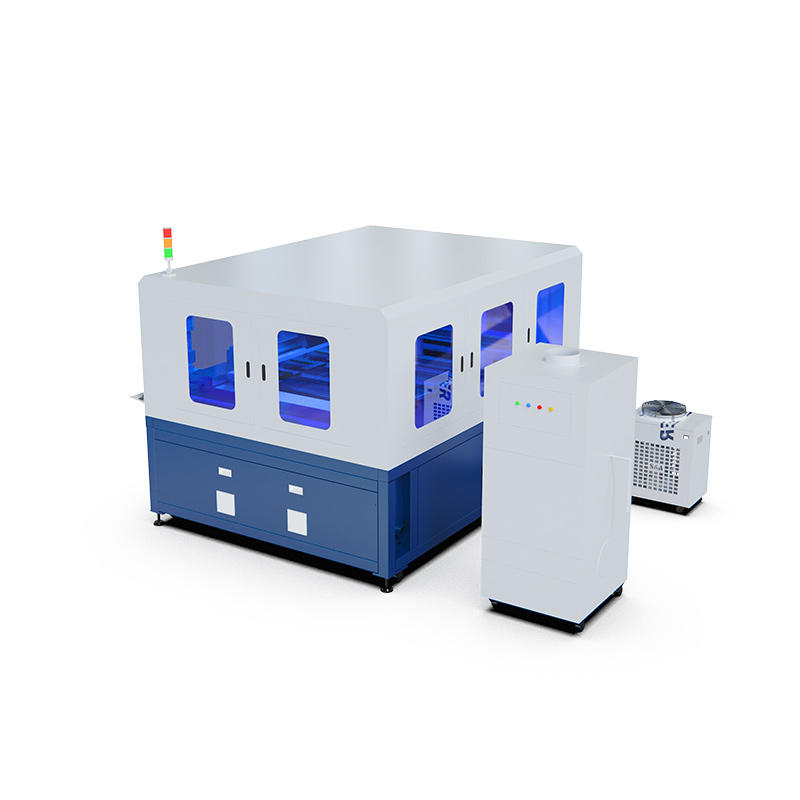
CO2 laser systems utilize a fascinating thermodynamic principle. The machine directs intense localized infrared heat precisely along the intended cut path. A highly targeted cooling jet immediately follows the heat source. This rapid temperature fluctuation creates a perfectly controlled internal fracture. The material essentially unzips itself along the microscopic stress line. This method excels at processing thicker architectural panels and producing long straight lines. It remains highly beneficial for cost-sensitive industrial applications. However, thermal stress splitting struggles to execute tight internal radii. It offers lower precision on complex internal geometries compared to ablative methods.
Ultraviolet (UV) systems operate on an entirely different photon wavelength. UV beams deliver extremely high photon energy directly to the material surface. This intense energy breaks molecular chemical bonds directly. The process generates minimal residual heat transfer. Facilities use UV systems to achieve excellent mid-range precision. They perform exceptionally well on frosted materials or chemically coated substrates. UV technology also provides superior surface texturing capabilities prior to the final separation step.
Ultrashort pulse (USP) technology represents the pinnacle of modern material processing. These systems emit light pulses measured in trillionths or quadrillionths of a second. This technology relies on cold ablation. The laser beam vaporizes the solid structure instantly. The material transitions into plasma before any heat can transfer laterally into the surrounding area. USP systems stand as the absolute best choice for ultra-thin panels and OLED screens. They execute incredibly complex curves flawlessly. Most importantly, they deliver absolute zero-taper edge requirements. They do require strict environmental climate controls to maintain beam stability.
| Laser Technology | Primary Mechanism | Best Suited For | Edge Quality |
|---|---|---|---|
| CO2 Laser | Thermal Stress Splitting | Thick panels, straight lines | Smooth, but limited geometry |
| UV Laser | Photochemical Bond Breaking | Coated substrates, frosted surfaces | High precision, minimal heat |
| Ultrashort Pulse (USP) | Cold Ablation | Ultra-thin displays, OLEDs, microchips | Pristine, zero-taper, no micro-cracking |
Production managers must carefully balance their required cycle time against acceptable chipping tolerances. Faster beam movement naturally reduces the overall cycle time. However, excessive speed can compromise the final edge smoothness. Certain architectural applications easily tolerate minor edge imperfections. Conversely, consumer electronics demand absolute perfection. A standard acceptable chipping tolerance for ultrashort pulse systems sits below 10 microns. You must define your exact tolerance parameters before evaluating specific machine speeds.
A standalone machine rarely solves complex manufacturing bottlenecks. You must assess how easily the equipment integrates into your existing production floor. Modern facilities rely on automated material handling. Verify compatibility with your existing robotic gantry loaders and automated guided vehicles (AGVs). Precision processing also requires advanced machine vision alignment systems. The machine must independently recognize fiducial markers to adjust cut paths dynamically. Additionally, ensure the equipment controller communicates seamlessly with your facility's ERP and MES software. Real-time data logging prevents unexpected production downtime.
Never assume all transparent substrates behave identically under a focused beam. Different chemical compositions exhibit radically different photon absorption rates. Pure fused silica features excellent thermal stability but requires immense peak power to process. Standard soda-lime panels react strongly to localized heat and split easily. Borosilicate materials sit somewhere in the middle regarding thermal expansion. You must rigorously verify machine performance across your specific material catalog. Request extensive test data covering every specific composition you plan to process.
We must address a critical physical limitation regarding strengthened materials. It remains physically impossible to safely laser-cut fully tempered glass. The tempering process locks massive internal compressive stress into the outer layers. Simultaneously, it traps immense tensile stress inside the core. Any attempt to cut the surface disrupts this delicate internal energy balance. The panel will violently shatter into thousands of pieces instantly. All machining, hole-drilling, and laser cutting must occur strictly *before* the final tempering process takes place.
Industrial beam processing demands rigorous facility infrastructure upgrades. Laser ablation vaporizes solid silica into microscopic airborne dust. You must install industrial-grade fume extraction systems to remove these hazardous vapors safely. Standard HVAC systems cannot handle abrasive particulate loads. Furthermore, advanced optical resonators require incredibly stable ambient temperatures. Minor temperature fluctuations cause the structural frame to expand, throwing the focal depth out of alignment. Finally, facilities must construct dedicated Class 4 laser safety enclosures. These enclosures require interlocked safety doors and specialized optical viewing windows to protect nearby personnel.
Transitioning from mechanical CNC operations to photonics requires a significant paradigm shift. Operators no longer monitor physical tool wear or spindle speeds. Instead, they must master complex parameter tuning. Technicians manage pulse duration, repetition frequency, and highly sensitive focal depth adjustments. This transition demands comprehensive vendor training programs. Factor mandatory on-site training weeks into your implementation timeline. Your internal maintenance team must also learn routine optical cleaning procedures to prevent lens damage.
Never procure complex capital equipment based solely on marketing brochures. You must mandate a comprehensive Proof of Concept phase. Advise your procurement team to demand extensive sample testing. Send your exact material batches to the equipment integrator. Microscopic impurities within your specific raw materials can drastically alter thermal absorption dynamics. A successful PoC guarantees the machine will hit your required cycle times and edge tolerances in reality.
Investing in advanced laser processing fundamentally changes your manufacturing economics. We shift operational costs away from unpredictable manual labor and extensive material waste. By eliminating post-processing stages and drastically reducing breakage, facilities unlock unprecedented production efficiency. This upfront precision technology future-proofs your fabrication capabilities against increasingly strict industry standards.
To successfully navigate this technological transition, we recommend the following immediate next steps:
Audit Current Scrap Rates: Quantify your exact financial losses attributed directly to mechanical edge chipping and post-processing breakage.
Define Quality Tolerances: Establish your absolute maximum allowable edge defect size in microns.
Initiate Material Testing: Ship physical samples of your most difficult substrates to two or three shortlisted equipment integrators.
Evaluate Integration Needs: Map out your current robotic loading pathways to ensure seamless factory floor integration.
A: No. Cutting disrupts the internal stress balance of tempered glass, causing it to shatter instantly. Glass must be cut prior to the tempering process.
A: While ultrashort pulse lasers excel at ultra-thin glass (<2mm), specialized CO2 setups utilizing thermal stress splitting can process glass upwards of 10mm to 19mm, depending on the required edge quality.
A: In most high-end applications (especially with femtosecond lasers), the cut edge is pristine and requires zero mechanical polishing, significantly reducing production time.


